
Re-Entry Center Release Paths
Baker Re-Entry Center is an FDC state component at a distinct Sanderson address. Re-entry in the facility name does not mean the person has already left prison custody. A resident can remain legally confined while taking part in release preparation. The state term ends only through the release mechanism shown in FDC records or through another authorized custody outcome.
After a true FDC discharge, a person may return to the community without state supervision, enter probation, parole, conditional release, community control, or another listed supervision type, or be delivered to a different authority. An internal move to another FDC prison is not release. A detainer can also cause continued custody after the Florida prison term reaches its endpoint. Read the release date, release flag, incarceration history, and detainer data together.
| Outcome | Record signal | Where to verify |
|---|---|---|
| Completed FDC discharge | Past date with a valid release flag | FDC Inmate Release detail |
| State supervision follows | Matching active supervision record | FDC Supervised Population |
| FDC transfer | New active institution | FDC Inmate Population |
| Other authority takes custody | Detainer or other-custody flag | Named receiving agency |
Confirm Re-Entry Center Discharge
Start with the FDC Inmate Release database. It accepts last name, first name, and the six-character DC number. Search by DC number when possible, because names and aliases can produce several results. Open the matching person and compare birth information, photograph, prison history, and identifiers before interpreting the date.
FDC includes both released people and people scheduled for release in this database. For that reason, use a four-part check:
- Read the
PrisonReleaseDateand the release-date flag on the detail record. - Search the active Population database to see whether FDC still reports a current institution.
- Search Supervised Population if post-prison state supervision is expected.
- Contact the Bureau of Admission and Release when a future date, release flag, detainer, or conflicting result remains unclear.
The Baker County release records hub shows why this FDC path differs from a county jail release. The Baker sheriff live roster should not be used to decide whether a Baker Re-Entry Center resident was discharged.
Baker Re-Entry State Evidence
Current official evidence includes active July 2026 OBIS assignments to BAKER RE-ENTRY CENTR. That state data matters because nearby campus sources conflict about other Baker correctional components. The former Baker CI main unit has reported immigration reuse, while recent FDC annual reports call the CI and work camp closed. The re-entry center has its own address and phone, and its active assignments should not be erased by broad statements about closure elsewhere on the campus.
Historical state material described Baker Re-Entry Center as a 432-bed male facility opened in March 2015. It also described re-entry eligibility for people within 36 months of release to served counties. Those figures explain the original model, but they are historical context. They are not a current population count, current admission rule, or promise that each resident has a release date within that span.
Use current FDC records for the individual. Historical program numbers should never substitute for a named release or discharge record.
Re-Entry Center Source Check
The official FDC Baker Re-Entry Center page is the facility-matched source captured for this page.
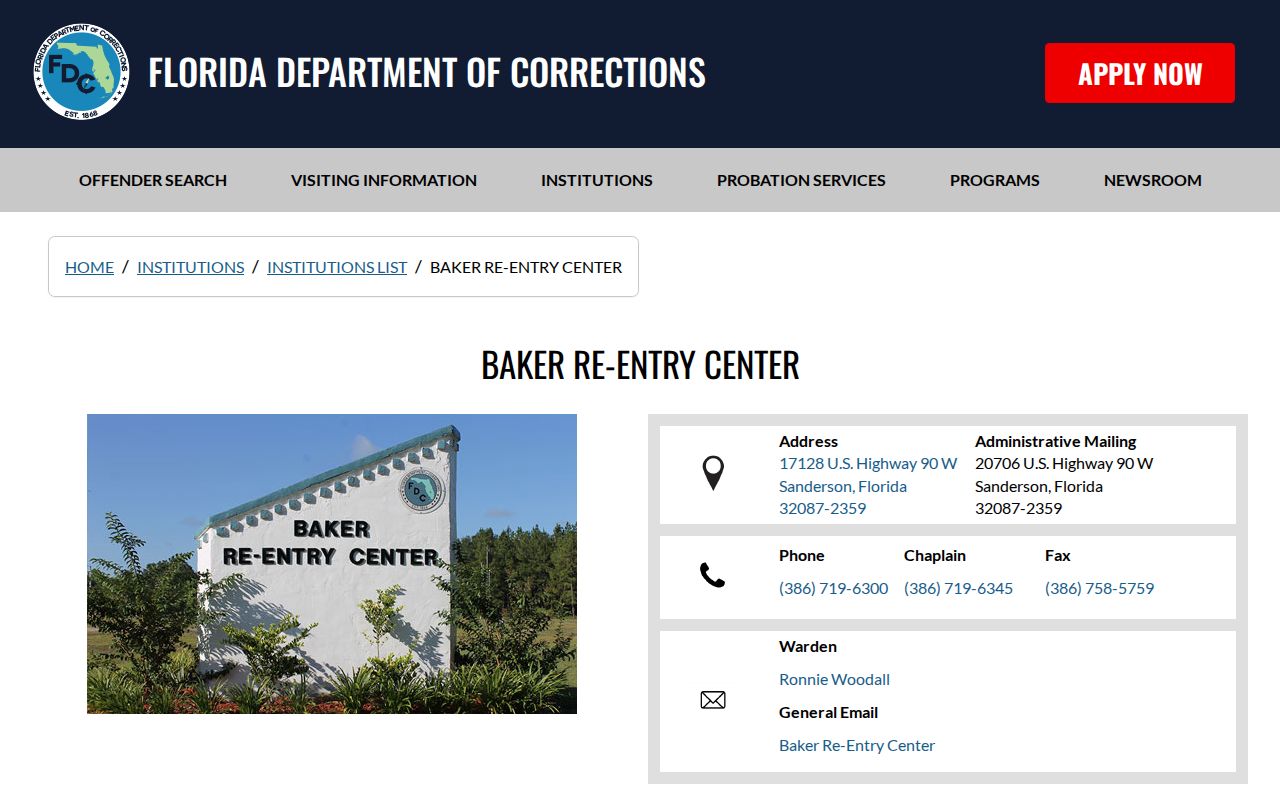
The state source anchors the center to FDC, so release checks belong in the statewide prison databases and FDC records channels.
Facility pages can change or fail to render while offender databases remain available. If the page and the person record differ, save the date of each check and contact FDC. A static facility description does not override a current person-level population or release result.
Re-Entry Release Date Meaning
Florida uses related terms that answer different questions. PrisonReleaseDate is the public OBIS field. The public search calls it a release date. Section 944.275 uses tentative release date for the calculated date affected by lawful credit and gain time. A future value is projected. It is not the same as a completed discharge timestamp or a guarantee that the person will leave to the community.
FDC calculates the maximum sentence expiration from the sentence and lawful credit, including qualifying jail credit. Gain time may move the tentative date earlier; forfeiture can move it later. New sentences, corrected credit, mandatory minimums, escape time, detainers, and parole or conditional-release decisions can change the practical outcome. Qualifying post-October 1995 sentences are subject to the statutory 85 percent floor for incentive gain time, but that floor is not a release promise.
- Tentative date
- A projected FDC date that can lawfully change.
- Release flag
- The coded description that explains how FDC classifies the date.
- Discharge
- The end of the state custody authority at issue.
- Supervision
- Rules enforced in the community after prison or through a court sentence.
Note: VINE can report an eventual event, but it does not calculate the sentence or replace FDC's release record.
Re-Entry Discharge Records
The public result may be enough for a simple status check. A formal release history may require the FDC GovQA records portal. Give the committed name, aliases, DC number, date of birth when known, approximate release period, and the precise record sought. Useful items include release/discharge history, incarceration intervals, release authorization, detainer disposition, and the public offender photograph.
Florida public-record law allows fees for copies and extensive service in specified circumstances. FDC may give an estimate before work begins. Some prison records are confidential, including protected medical, investigative, victim, and security information. Ask for segregable, nonexempt release fields if parts of a file must be withheld or redacted.
FDC also states that sealed and expunged records are removed from its public bulk data. A missing result does not prove the person never entered the state system. Spelling, aliases, identifier errors, refresh timing, legal restrictions, and custody moves should all be considered before drawing a conclusion.
Re-Entry Center Contact
The center's direct contact is useful for facility routing. Sentence calculations and official release flags belong to the Bureau of Admission and Release. The state public-records office handles record production. Calling the Baker County detention line will not produce an authoritative FDC re-entry discharge record.
17128 U.S. Highway 90 West
Sanderson, FL 32087
Facility phone: 386-719-6300
FDC Bureau of Admission and Release
850-488-9167
dc.release@fdc.myflorida.com
FDC public records lists James Best at 501 S. Calhoun Street, Tallahassee, FL 32399, with assistance at 850-717-9774 and fax at 850-488-4534. Keep the DC number in every contact because it is the clearest link between the person and the state record.
After Re-Entry Center Release
A Supervised Population result can show that a person is outside prison under FDC supervision, but it does not supply the exact physical gate time. The database accepts a name or DC number and covers state felony and post-prison supervision. It does not cover Baker county-court misdemeanor probation. Read the judgment and release papers before deciding which office controls the next step.
If a detainer appears, contact the listed authority. The end of the FDC term can lead directly to another custodian. If no detainer is shown and the valid release date is past, compare the release detail with any supervision record and available VINE event. These records together distinguish discharge, continued state custody, and post-release supervision.
Where did the person go? The public record may name a supervision office or another custodian, but it may not publish a private destination. Request the official release record rather than guessing from a program name.