
Baker County Release Date Types
A scheduled or projected date is a forecast based on the sentence, lawful credit, and the rules applied by the custodian. An actual date records the completed custody exit. The distinction is critical. A future date can change, and a date that ends one agency's custody may lead straight to another custodian. Baker County Detention Center holds local, outside-county, federal, and immigration populations, so a local charge ending does not always mean a return to the community.
A pretrial Baker County detainee generally has no computed sentence release date. A bond, recognizance order, dismissal, first-appearance action, or other court event may make release possible, yet a warrant or detainer can prevent the physical exit. A sentenced county inmate may have a date the detention center can provide. A Florida state prisoner has an FDC calculation. Federal BOP and ICE records use their own date and status terms.
| Custody type | Date source | Main limit |
|---|---|---|
| Baker pretrial custody | Court docket, jail, and bond order | No fixed sentence date may exist |
| Sentenced county jail term | Jail phone, sentencing order, release record | No public Baker calculation formula was found |
| Florida state prison | FDC Population and Inmate Release searches | Tentative date can move |
| Federal or immigration custody | BOP, federal docket, or ICE | Leaving one system may mean transfer |
Find Baker County Release Dates
Identify the last known custodian before using a date. The Baker sheriff's current roster only shows people reported in custody. It does not publish a projected release field or a recent-release archive. For a sentenced county inmate, call the 24-hour information line and ask whether a release date is available. The sheriff's corrections FAQ states that staff may provide such a date for a county-sentenced person, but not for someone held for another jurisdiction.
For a state prisoner, start with the FDC Inmate Population search. Search by the six-character DC number when possible. Otherwise use the name and alias tools. Open the correct identity and note the public release date. Then cross-check the FDC Inmate Release search, which includes people already released and people scheduled for release. A hit by itself does not prove the discharge happened.
- Determine whether the person is pretrial, county-sentenced, in FDC, or held for another authority.
- For Baker County custody, check the criminal docket for the sentence, bond event, jail credit, and any later hold.
- Call 904-259-3311 for a county-sentenced date and ask which agency controls any outside-jurisdiction hold.
- For an FDC term, compare the active Population result, Inmate Release result, release flag, and detainer information.
- Verify the final release or transfer with the responsible agency rather than treating the forecast as an exit receipt.
The official FDC active-population lookup displays the state record used for the comparison.
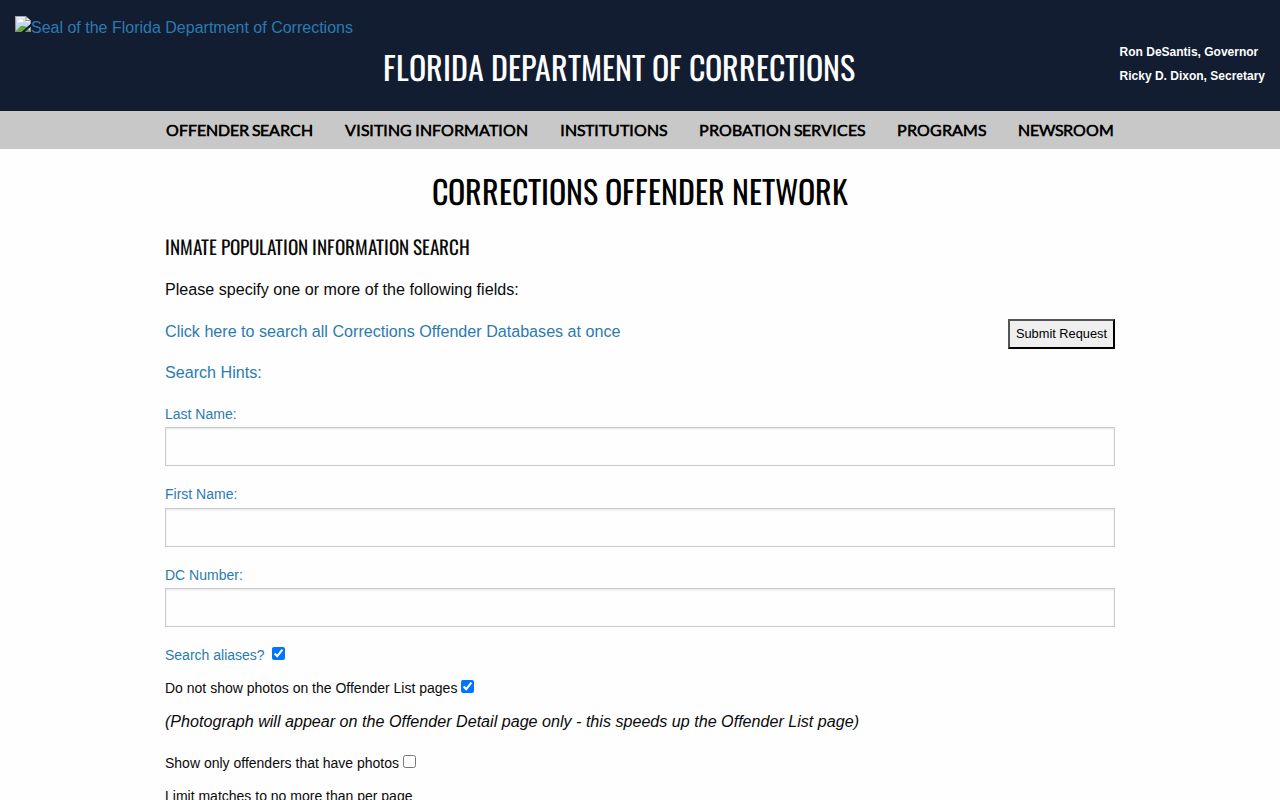
The state screen can supply a date for an FDC sentence, but it cannot calculate a short Baker County jail term that never entered state prison custody.
Note: The sheriff roster supports present Baker County custody only; a missing name is not proof of release.
Baker County FDC Date Labels
Florida uses three closely related terms. The public OBIS data calls the field PrisonReleaseDate. The reader-facing search calls it a release date. Florida Statutes use “tentative release date” for the calculated state-prison date. These labels may point to the same expected event, but their context matters. A past prison release date paired with a valid-release flag strongly supports discharge from FDC. A future date remains a projection.
Read the release flag as well as the date. Official data may identify a valid release, death, or a coterminous end of Florida and other state or federal custody. A coterminous flag can show that FDC's part ended while another term remained. FDC incarceration history shows the receipt and release dates for state-prison periods. Its detainer table can name another authority and help explain why the person did not return to Baker County.
FDC says the public Inmate Release search updates nightly. Bulk OBIS data refreshes on a different schedule, generally monthly around the first. A disputed date should go to the Bureau of Admission and Release at 850-488-9167 or dc.release@fdc.myflorida.com. Database timing is one reason two official screens may briefly differ.
Release dates also need the right geographic meaning. A record from Baker Correctional Institution State Components or Baker Re-Entry Center belongs to the statewide FDC system. It should not be checked through the county sheriff roster. A move between FDC facilities is still state custody, while a discharge may be followed by an FDC Supervised Population entry. At the overlapping Sanderson campus, verify which custodian appears on the person's papers before assigning any date to FDC or immigration authorities.
Florida Release Date Calculation
For an FDC prisoner, the calculation begins with the maximum sentence expiration date. FDC applies the sentence or sentences and lawful credit, including court-awarded jail credit. It then establishes a tentative release date affected by gain time. Gain time is credit that can advance a qualifying prisoner's tentative date. It is not an automatic promise. Awards, restoration, forfeiture, offense eligibility, mandatory minimums, and court corrections all matter.
Under Florida Statutes section 944.275, qualifying offenses committed on or after October 1, 1995 may earn up to ten days per month of incentive gain time. The same law prevents gain time from producing release before at least 85 percent of the imposed sentence has been served for the covered group. Credit for time physically incarcerated counts toward that floor.
The 85 percent rule is a minimum-service threshold, not a promise that release occurs at exactly 85 percent. An ineligible offense, mandatory minimum, disciplinary forfeiture, life term, or another rule can require more. Older offense dates can fall under different gain-time provisions. A Baker county jail sentence does not use this FDC prison formula. For that local term, rely on the sentencing order, jail credit, the jail's calculation, and the final release record.
Note: Never apply the FDC 85 percent floor as a shortcut for a Baker County jail sentence.
Why Florida Release Labels Shift
The mix of OBIS PrisonReleaseDate, public “release date,” and statutory “tentative release date” can make one Baker County record appear more certain than it is. Section 944.275 makes the tentative date movable. Gain-time awards or restoration can advance it. Withholding or forfeiture can delay it. A later sentence or corrected court credit may force a new calculation.
The database field is still useful when read with the person's live status. If the date is ahead and the active Population result remains current, treat it as projected. If the date has passed, review the release flag, incarceration history, detainers, and supervision record. This three-label check is the distinctive Florida safeguard against turning a calculation into an unsupported claim of actual release.
Baker County Date Change Factors
A valid forecast can change before release. Some changes alter the sentence computation. Others do not change the FDC term but change where the person goes when it ends. The distinction matters in Baker County because county, state, federal, and immigration systems overlap. A detainer can turn a planned discharge into a handoff.
| Event | Effect on the release outcome |
|---|---|
| Gain time awarded or restored | May move an eligible FDC tentative date earlier, subject to the statutory floor. |
| Gain time withheld or forfeited | May move the state date later. |
| New sentence before release | May require FDC to establish new expiration and tentative dates. |
| Court correction of jail credit | Changes credit used in the calculation. |
| Mandatory minimum or ineligible offense | Can block an ordinary incentive gain-time outcome. |
| Detainer or other jurisdiction | Can cause transfer or continued custody when one term ends. |
| Parole or conditional-release action | Can create a different lawful release and supervision path. |
| Database correction or lag | Can change the public display without changing the underlying order. |
Section 944.291 also places certain repeat, habitual, or violent habitual offenders on a conditional-release path and requires advance identification to the Florida Commission on Offender Review. The commission action may therefore matter alongside the FDC calculation. A parole docket is not a final decision, and a proposed date is not a physical exit.
Baker County Jail Date Checks
A Baker County pretrial release follows the court and jail, not FDC gain time. Search the Baker criminal docket for first appearance, bond, recognizance, dismissal, plea, judgment, sentence, jail credit, probation, and later warrants or violations. The docket can show why a person became eligible to leave. It may not show the exact minute the jail completed release.
Ask the sheriff for the booking and release record if the date is disputed or historical. Request the booking number, admission time, release date and time, release type, responsible agency, and any public transfer destination. The records form lists the information requested, name, and contact email fields, but it publishes no fixed fee or turnaround. Under Florida public-record law, exempt material can be redacted while nonexempt fields are produced.
Someone held for ICE, USMS, BOP, another county, or another state must be routed to that custodian. The Baker corrections FAQ expressly limits the county's ability to supply release dates for other jurisdictions. A local roster disappearance may be transfer, agency return, or a data change.
Confirm Baker County Release Events
Use alerts as notice, not as the calculation source. Florida VINE can report a custody event from a participating jail or FDC. “Out of Custody” means the reporting source marked the person out of that custody. It does not rule out a transfer. The Baker County VINELink release check explains the one-person search and registration steps.
For a completed release, preserve the final agency record and compare it with the court or FDC source that authorized the event. The Baker County released inmate records path covers the full jail, court, state, federal, and immigration sequence. That final comparison answers both when one custody ended and whether another authority took control.