
Baker County Parole and Probation
Parole is supervised release from a prison sentence under authority of the Florida Commission on Offender Review. It now applies mainly to older or narrow classes of Florida cases because ordinary parole eligibility largely ended for later offenses. Probation is a court sentence served in the community instead of, or after, confinement. Community control is a stricter form of supervision with limits set by the court. Conditional release is a post-prison form created by statute for certain inmates. These labels identify different legal paths, so a Baker County parole and probation check should use the exact term shown on the judgment or FDC record.
The supervising body also changes. The Florida Department of Corrections handles state felony probation, community control, and post-prison supervision. The Florida Commission on Offender Review makes parole and certain conditional-release decisions. Baker County court misdemeanor supervision may instead be assigned to Tri-County Probation. A person may be free from a jail cell while still subject to reporting rules, travel limits, payments, treatment, or other court-approved conditions.
| Status | Who sets it | Best verification source |
|---|---|---|
| Parole | Florida Commission on Offender Review | FCOR final action and FDC supervision record |
| Felony probation | Florida circuit court | FDC Supervised Population search and judgment |
| Misdemeanor probation | Baker county court | Judgment and assigned county probation provider |
| Conditional release | Statute, FCOR, and FDC | FDC release record, FCOR action, and supervision result |
- Discharge
- The formal end of a term of custody or supervision.
- Absconder
- A person reported as no longer making themselves available for required FDC supervision.
- Revocation
- An official action ending supervision because of a proven violation, often with a new custody result.
- Detainer
- A notice that another authority may take custody when the current term ends.
Verify Baker County Supervision
Start with the Baker County judgment, release papers, or FDC result. Those papers should identify whether the case is a state felony, county misdemeanor, parole matter, or federal case. Then use the database tied to that authority. The FDC Supervised Population Information Search accepts a last name, first name, or DC number and offers alias and photo options. FDC says most supervised-population data refreshes weekly, while termination dates and location changes update nightly.
A state result can support that someone is outside prison under FDC oversight. It does not state the exact time the person left the Baker County Detention Center. Likewise, no result does not rule out Baker misdemeanor probation. If the supervision type is unclear, compare the court judgment, the FDC Inmate Release result, and the named office on the person's paperwork.
- Read the court judgment or release paper and note the case number, supervision type, and named agency.
- For state supervision, search FDC by DC number first, then by name and aliases if needed.
- Compare the identity, supervision status, office, and termination data with the court file.
- For a county misdemeanor, contact the assigned Baker probation provider rather than relying on FDC.
- For parole or conditional release, obtain the FCOR action and confirm the current FDC supervision entry.
The official FDC supervision search is shown in the captured source below.
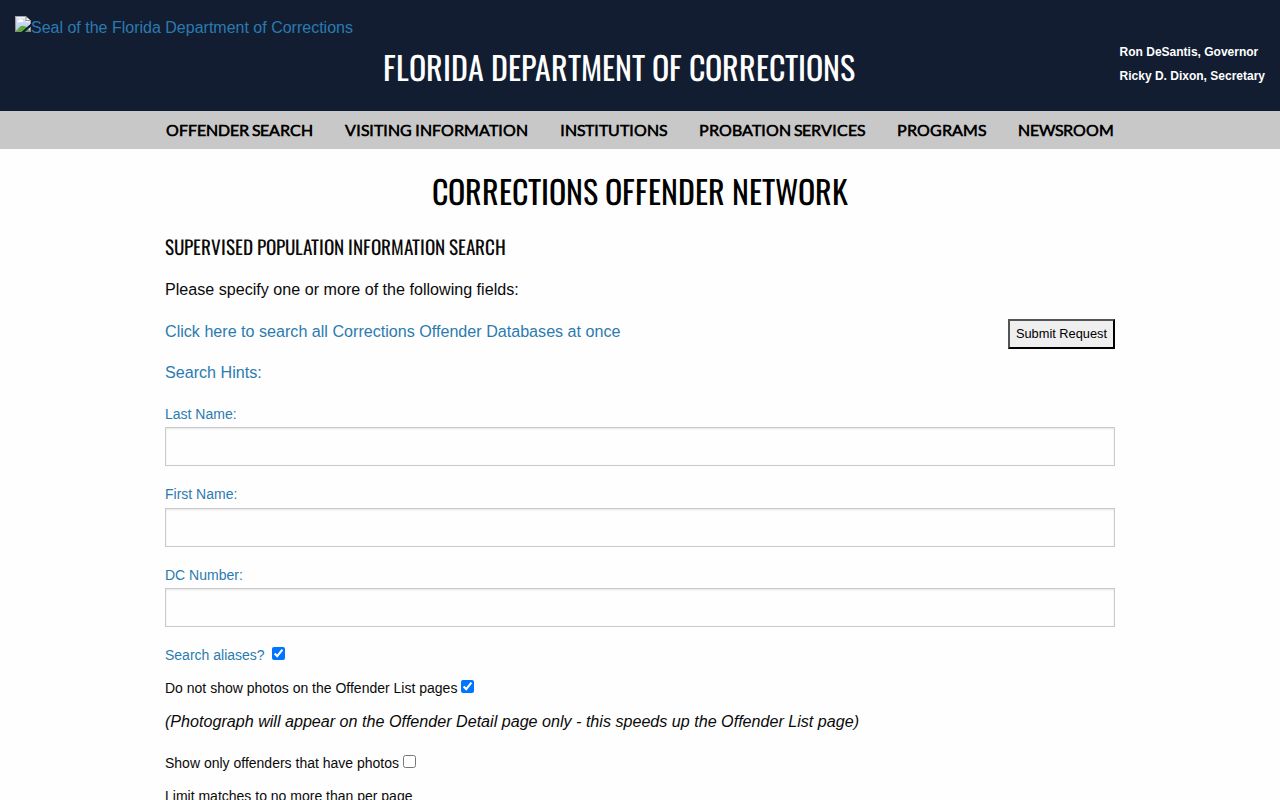
Its record is the state supervision layer, so the court judgment remains vital when Baker County misdemeanor supervision or a disputed status is involved.
Note: A supervision result confirms the reported oversight status, not the exact Baker County jail release timestamp.
Baker County Supervision Offices
Baker County has two adult probation routes that cannot be merged. FDC Circuit 8 serves Baker and nearby counties for felony and post-prison cases. Its listed serving location is Starke Office 082. The state field-services line can also route questions about an FDC result. County-court misdemeanor cases may use Tri-County Probation in Macclenny under the local arrangement documented by Baker County. The current assignment should still be checked against the judgment because contracts and individual officer assignments can change.
FDC Circuit 8, Starke Office 082
1250 East Andrews Street, Suite N2
Starke, FL 32091
904-368-3600
State felony and post-prison supervision serving Baker County.
Tri-County Probation, Inc.
56 North 2nd Street
Macclenny, FL 32063
904-259-3022
County-court misdemeanor supervision; confirm the live assignment from the judgment.
For broad state questions, FDC Probation and Parole Field Services lists 850-717-3444 and co-supervision@fdc.myflorida.com. The Circuit 8 office directory identifies the serving area and office contact. A federal supervision term uses U.S. Probation, not either Baker County route.
Baker County Supervision Conditions
The judgment, FCOR action, or supervision order is the source for a person's actual conditions. Depending on that order, oversight may require reports to an officer, approved residence or travel, compliance with court costs, treatment, testing, or other stated terms. Do not infer a condition from the supervision label alone. Two people with Baker County probation records can have different duties, and parole or conditional release follows its own controlling action.
To verify a disputed condition, obtain the signed order and contact the office shown on the record. FDC's public result is useful for status, office, and termination data, but it may not reproduce every instruction given to the person. A county misdemeanor question belongs with the assigned Baker provider and county court. A felony or post-prison matter belongs with FDC, while an FCOR order controls the commission action. Keeping those sources separate also prevents a missed report from being described as a new arrest before an agency or court has acted.
Supervision can end by successful completion, early termination where authorized, expiration, revocation, or another formal action. Only the responsible court, FDC, or FCOR record establishes that end. A projected termination date remains subject to later changes in the case.
Baker County Absconder Records
An absconder entry means FDC reports that a supervised person stopped making themselves available as required. It is not proof that the person is now in the Baker County jail. Search the FDC Absconder and Fugitive database, then check the court and responsible agency for any warrant or later custody event. FDC lists an Absconder Unit phone line for weekday questions, but Baker County does not publish a sheriff warrant database that can replace an official court or agency check.
Violations can lead to a warning, added conditions, a violation report, arrest, revocation hearing, or a return to custody. The outcome depends on the order and deciding authority. A VINE alert may report a custody change, but it does not decide whether supervision was revoked. For a released Baker County person, keep the supervision case and any new jail booking separate until the records connect them.
Note: An alleged supervision violation is not a final revocation; the court or commission action supplies the binding result.
Baker County Parole Action Records
The FCOR voting calendar lists multiple monthly dates and session types. Its dynamic agenda may show a person's name, DC number, county, offense, case number, and hearing category. An agenda is a docket, not the final outcome. It can identify an initial interview, final parole hearing, supervision review, conditional-release review, or another commission matter without proving what the commission decided.
No public person-name final-decisions search was found. Request the final action from FCOR public records using the name, DC number, hearing date, and case number. Possible actions include authorizing parole, declining it, setting or extending a presumptive date, postponing review, rescinding release before physical discharge, modifying supervision, revoking it, restoring it, or ending it. The final order should then be checked against the FDC release and supervision records.
Baker County Release Identification
Florida law adds an identification step for some state-prison releases. Under section 944.605, FDC must coordinate specified identification documents before an expiration-of-sentence release for qualifying people. The process can include a certified birth certificate, state identification card, an appropriate replacement driver license, and help with a Social Security card. The law also addresses people born outside Florida and exceptions such as active detainers or some urgent releases.
This state discharge preparation rule should not be described as a Baker County jail property or ID service. It applies through FDC. A person leaving the county detention center should ask that facility about property and documents tied to the local booking. Someone leaving a Baker-area state component should use FDC's release plan and supervising office. Correctly naming the custodian avoids sending a county release question to the state probation office.
Baker County Supervision Discharge
A physical release and a supervision discharge are different dates. The first marks exit from custody. The second ends parole, probation, conditional release, or community control. FDC's termination field can help with state oversight, while the court docket or FCOR order records the legal action. If supervision was revoked, the later record may show renewed custody rather than a clean end.
Use the Baker County released inmate search and records path for the original custody exit. Then use the correct supervision agency for the later status. This two-record approach is especially important in Baker County, where state, county, federal, and immigration custodians may all appear in one person's history.